








Czech Manufacturer of Injection-Molded Plastics Bets on M365 and eWay-CRM
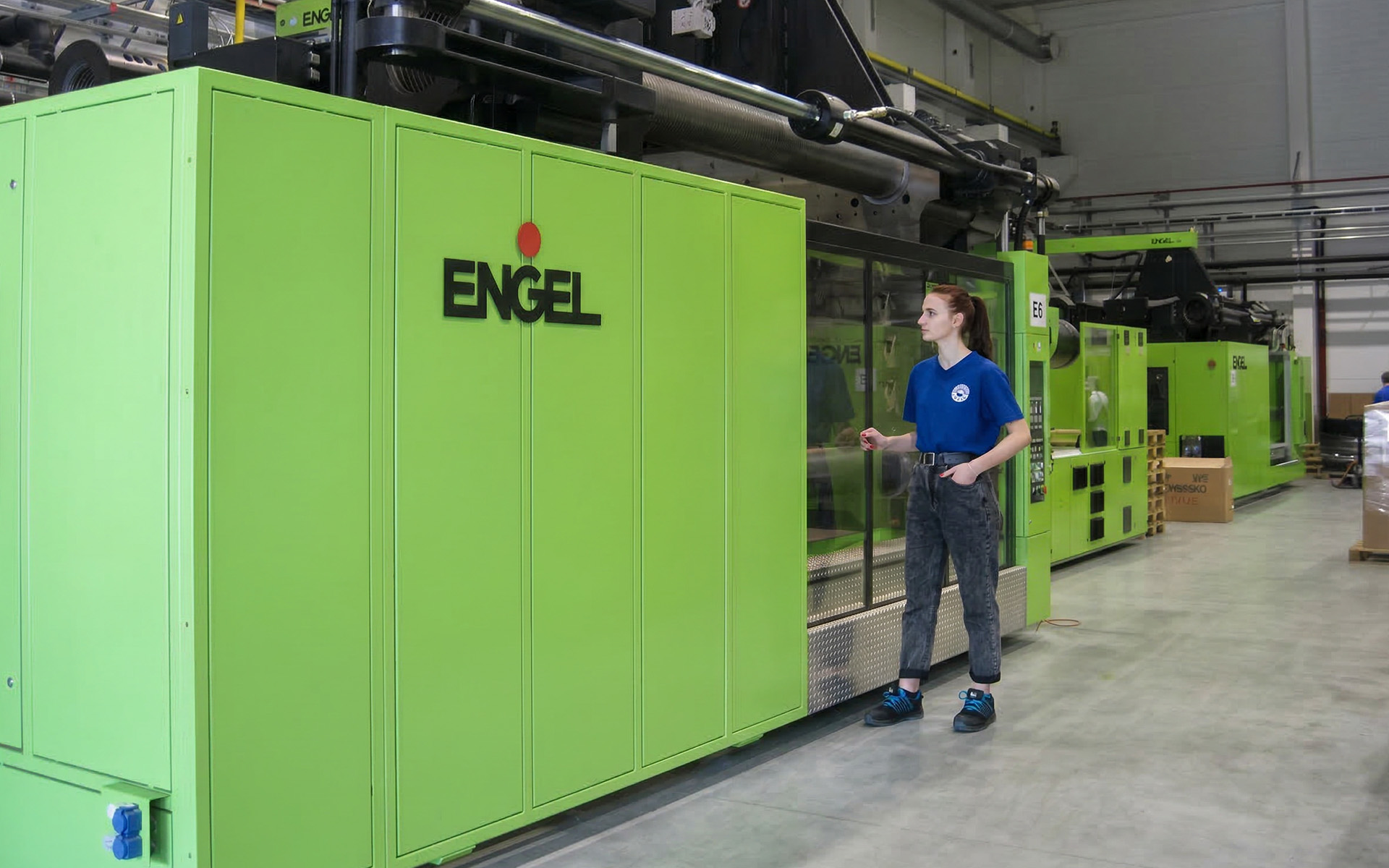
OKULA Nýrsko is a West Bohemian company with a history dating back to 1953. The general public mainly knows the company for contact lenses and optics, but today it is a completely different business: It now focuses primarily on injection-molded plastic parts for the automotive industry, heat pumps, air conditioning units, and household appliances.
The company’s key competitive advantage is not just the molded part itself. OKULA offers the entire production chain: plastic injection molding, painting, printing, and assembly. The customer receives a finished assembly, not just a semi-finished product.
1953 Founded | HVAC & automotive Main segments | Daikin, Bosch, Siemens Key partners |
COVID, China, and the end of government contracts
The past few years have not been easy for OKULA, but the company has demonstrated a remarkable ability to adapt. During COVID, part of its capacity was redirected to producing protective face shields — OKULA supplied both state material reserves and the general market. Paradoxically, the pandemic highlighted one of the company’s strengths: its ability to quickly pivot.
After COVID subsided, a different pressure emerged — cheap competition from China. OKULA withdrew from protective equipment and returned to its core business. Now it faces a more complex challenge: some European customers — manufacturers of appliances and components — are losing market share to Chinese competitors. As China imports cheaper finished products, European companies produce less — and therefore purchase fewer plastic parts from OKULA.
The response to this situation is customer portfolio diversification: deepening relationships with existing buyers while actively seeking new ones in segments less exposed to the same pressure. This strategy is one of the main reasons OKULA needed a CRM system.
Why most CRM systems don’t work for manufacturers
The CRM selection process took half a year, during which the company evaluated four offers. They discovered that most CRM solutions on the market are not designed for manufacturing companies. They are built for a completely different type of business.
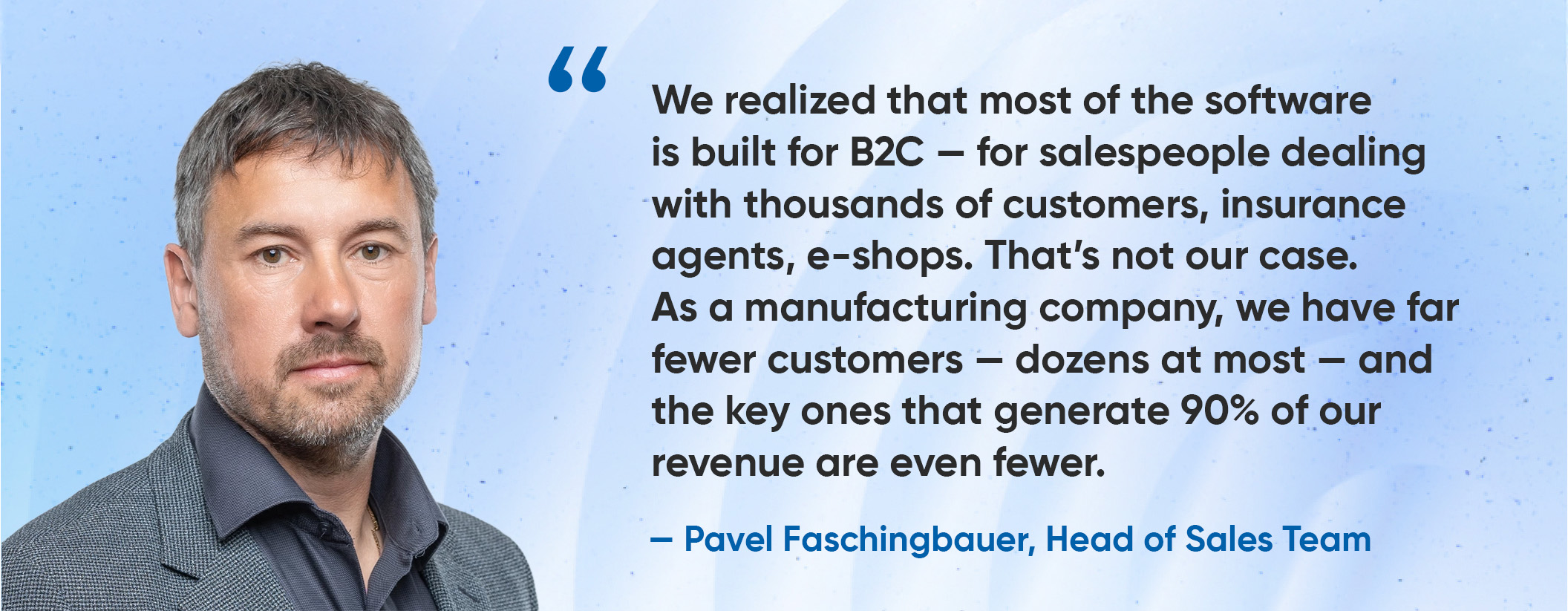
This distinction is critical. CRM systems for insurance agents or e-commerce optimize work with thousands of anonymous contacts, track conversions, and segment mass campaigns. But a B2B manufacturing company needs something different: deep knowledge of a small number of key customers, tracking of multi-layered organizational structures on the buyer’s side, and thorough documentation of communication — including specific projects and contracts.
eWay-CRM natively supports this model: the tool is designed to allow a company to maintain detailed records for each key customer, track communication at the project level, see who played what role on the customer’s side, and keep the entire thread in one place.
Another key factor in choosing eWay-CRM was its deep integration with Microsoft Outlook and M365. OKULA had just rolled out M365 across the department, so integration with a tool people were already using meant minimal disruption during implementation. A reference from another nearby company also helped.
Communication scattered across different locations
Before implementing CRM, OKULA faced a classic issue: customer information lived on individual salespeople’s computers or was stored on the company network without any clear structure. This works as long as everyone stays. But when a salesperson leaves, they take the entire customer relationship history with them.
The second dimension is time-related. Relationships with manufacturing customers are long-term: a project can last months, communication happens across multiple levels (purchasing, engineering, logistics), and the customer often doesn’t even remember what was agreed upon two years earlier. Searching for the right answer in an email archive is time-consuming and a source of potential mistakes.
Buying CRM isn’t the hard part — getting it adopted is
OKULA chose a self-implementation path without an external consultant. Pavel Faschingbauer openly admits that this is where they are hitting the biggest obstacles.
The issue isn’t technical — eWay-CRM works. The problem is organizational and time-related: rolling out CRM requires the company to dedicate capacity for learning, configuration, and living with the tool. In day-to-day operations where serving customers is the top priority, that’s a difficult task.
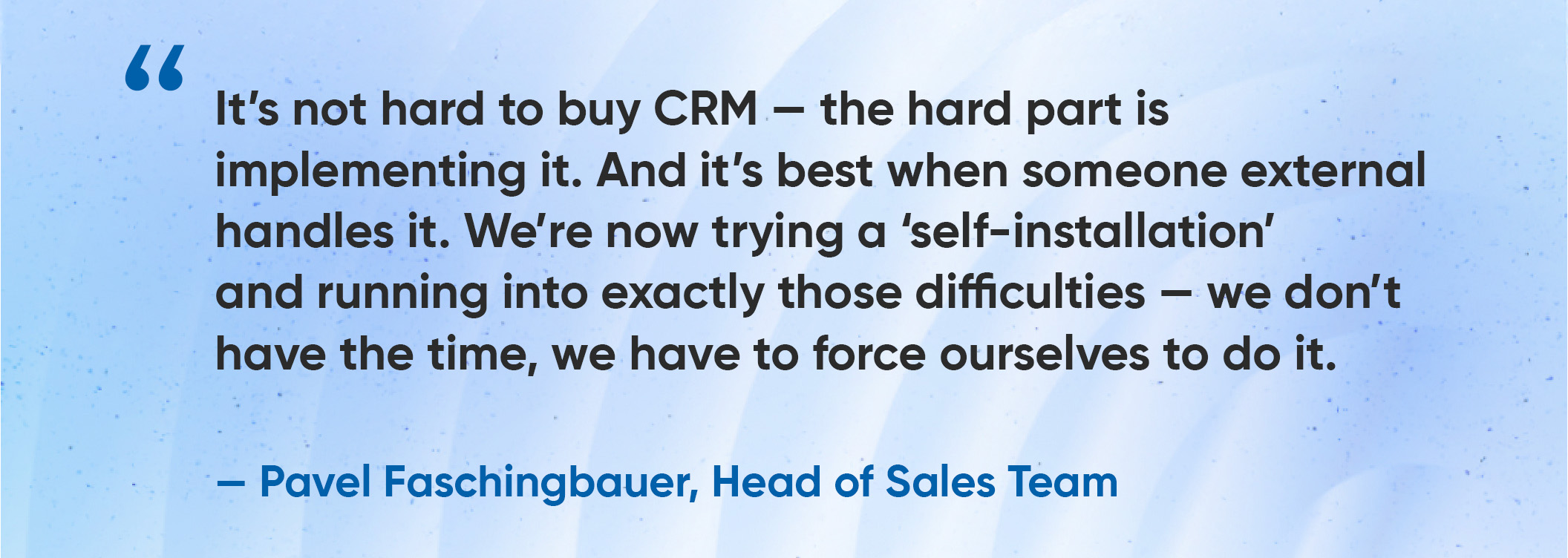
Faschingbauer has a clear request: he wants an implementation consultant from eWay-CRM to come on-site to the company. Not guide them via Teams calls or rely on watching YouTube videos. A physical visit where the consultant sees the real operation and says: “This is how you have it set up now — and this is how it can work better.”
This is an important general lesson for any CRM project: simply installing the system is not enough. It requires implementation work, process adaptation, and ongoing mentoring — ideally from someone who understands the customer’s daily reality while knowing the product well enough to tailor it properly.
What OKULA expects from eWay-CRM
Even though implementation is still recent, Faschingbauer’s expectations are specific and well structured. They fall into three main areas:
- Complete communication: 360° view of the customer
The primary goal: Any member of the sales team can open a customer record at any moment and see the full communication thread — regardless of who communicated and when. No more situations where the customer says “but we agreed on this” and the salesperson lacks historical context. - Reporting and dashboards with one click
The second goal is managerial. Faschingbauer wants instant visibility into inquiries, revenue, business trips, and sales team activities — without having to request complicated reports. CRM should turn manual reporting into something automated. - Access rights management
The third goal is security-related. The company has a board and management, and not all communication is meant for everyone. eWay-CRM offers access control that allows separation of who can see what.
- Manufacturing B2B companies have different needs than e-shops or insurance firms — a smaller number of key customers demands a CRM built for depth, not breadth.
- Integration with Microsoft Outlook/365 is a decisive factor for companies moving to the Microsoft ecosystem — it minimizes resistance to adopting a new tool.
- Scattered communication is a ticking time bomb — OKULA expects CRM to ensure continuity even when team members change.
- Self-implementation without an external consultant is possible but riskier — companies often underestimate the need for dedicated capacity and onboarding.
- The goal of “knowing more about the customer than they do themselves” is concrete and measurable — and eWay-CRM provides the tools for it through full communication threads.
- Automated reporting without manual spreadsheets and proper access rights management are just as important to management as the communication records themselves.
Looking for the same? Try now!
Click the button below and download eWay-CRM for free.
You can also book our consultant. We will make a demo just for you.